About Quad A Research Labs
Precision strain wave gears for the North American market.
Quad A Research Labs supplies precision strain wave gears manufactured in Taiwan to engineers and OEMs across North America. We carry the PCS (cup type) and PSH (hollow shaft) series in sizes 14 through 32, with standard reduction ratios of 50:1, 80:1, and 100:1. Custom ratios from 30:1 to 160:1, modified output shafts, and special mounting configurations are available on request.
Product Series
Sizes 14–32 · Ratios 50:1, 80:1, 100:1 · Custom configurations available
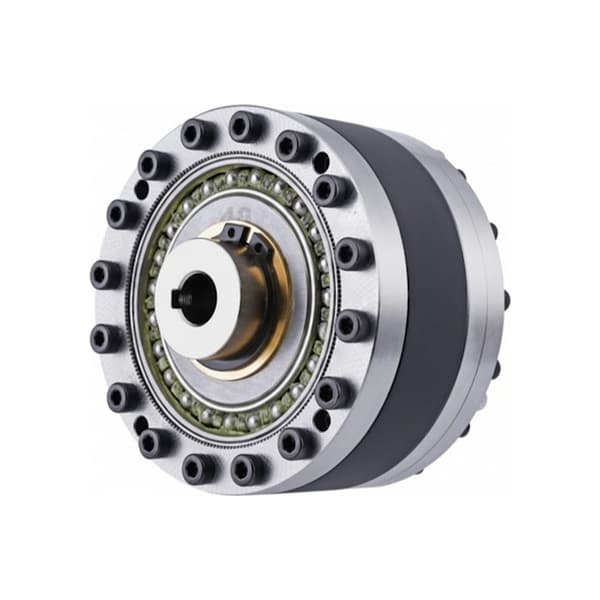
PCS Series
Cup type component set. High torque capacity, zero backlash, compact form factor for custom mechanical assemblies.
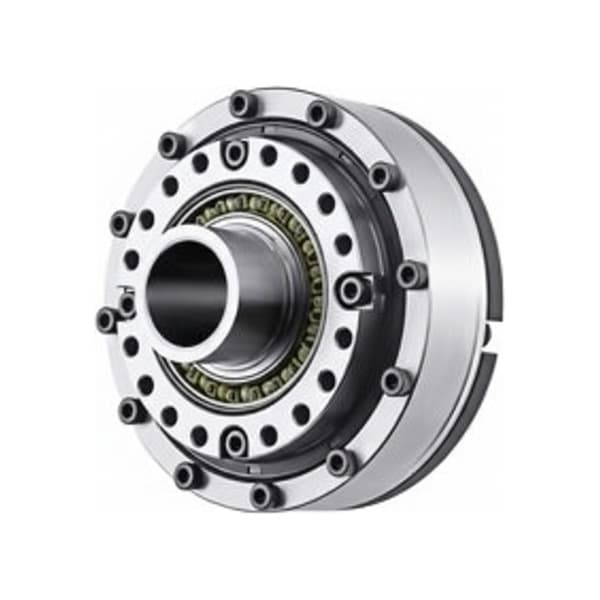
PSH Series — Hollow Shaft
Coaxial input/output with large-bore hollow shaft. Thin profile housed unit with cross roller bearing output.
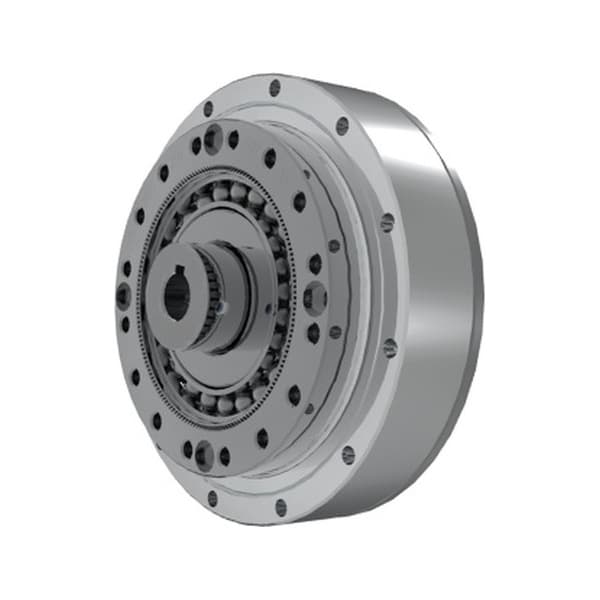
PSH Series — Oldham Coupling
Housed unit with Oldham coupling input for simplified motor connection and misalignment compensation.
Strain Wave Gear Technology
Operating principle, core components, and performance characteristics
Operating Principle
A strain wave gear transmits torque through the controlled elastic deformation of a thin-walled flexible element, achieving reduction ratios from 30:1 to 160:1 within a single compact stage. The mechanism consists of three concentric components — a wave generator (input), a flex spline, and a circular spline — working in concert through a unique multi-tooth engagement pattern that fundamentally differs from conventional involute gearing.
Core Components
Wave Generator
An elliptical cam fitted with a precision thin-raced ball bearing. As it rotates, it produces a traveling elliptical deformation in the flex spline, driving sequential tooth engagement at two opposing contact zones along the major axis.
Flex Spline
A thin-walled, cup-shaped element with external teeth machined on a slightly smaller pitch diameter than the circular spline. Its controlled elastic deformation is the core operating principle of the gear. In cup type configurations (PCS series), the flex spline serves as the output member.
Circular Spline
A rigid ring with internal teeth, typically fixed to the housing. It has two more teeth than the flex spline — this tooth count difference produces the reduction ratio. One full input revolution advances the flex spline by exactly two teeth relative to the circular spline.
Performance Characteristics
Linear Torsional Rigidity
The strain wave mechanism maintains consistent torsional stiffness across the entire operating torque range. Unlike multi-stage planetary gear trains, where compliance accumulates at each stage and produces nonlinear spring characteristics, the single-stage architecture delivers a predictable, linear spring rate in both rotational directions. This directly reduces settling time in closed-loop servo systems and enables higher control bandwidth.
Backlash Stability Over Lifecycle
With approximately 30% of the total tooth count in simultaneous mesh, load is distributed evenly across the tooth face, minimizing peak bending stress at the flex spline root — the primary fatigue point in the mechanism. This allows the gear to retain arc-second level backlash throughout its rated service life, rather than degrading progressively as in conventional gear trains.
Compact Envelope, Smooth Output
Single-stage reduction from 30:1 to 160:1 eliminates the need for cascaded gear stages, resulting in a shorter axial length and lower mass for a given torque rating. The progressive tooth engagement cycle produces inherently low vibration and acoustic noise, yielding a cleaner output signal that benefits sensitive downstream instrumentation.
Need help selecting a gear?
Send us your torque, speed, and envelope requirements.